

Real-time measurement of particle size, shape, and thickness in industrial processes

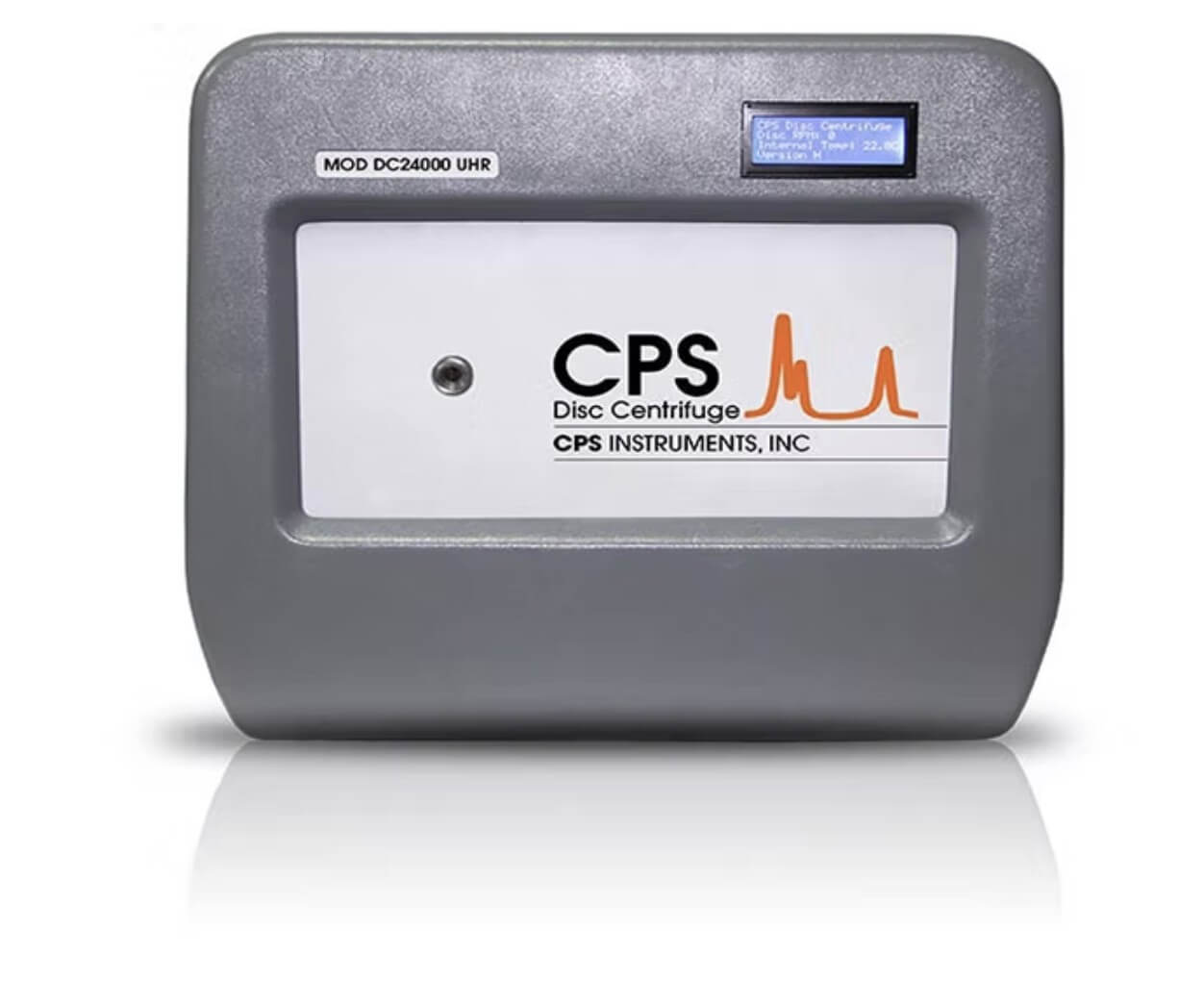
Gain valuable insight into your product properties with the CPS Disc Centrifuge. Accurately measure particle size distributions in suspensions and emulsions.
The CPS Disc Centrifuge uses Differential Centrifugal Sedimentation (DCS) to accurately measure particle size distributions in suspensions and emulsions. Particles are separated based on both size and density, allowing even small differences in particle size to be detected reliably. This provides a detailed view of the complete particle size distribution, including multimodal distributions, agglomerates, and contaminants.
The technique offers significant advantages over laser diffraction and Dynamic Light Scattering (DLS):
High-resolution particle size distribution analysis
Measurement range from nanometers to micrometers
Accurate analysis of multimodal particle size distributions
Reliable detection of agglomerates and contaminants
Typical reproducibility of ±1% or better for reported peak sizes
Excellent reproducibility and long service life
Suitable for both R&D and quality control
Provides insights where laser diffraction and DLS reach their limits
Suitable for liquid dispersions and solid particles after dispersion
The CPS Disc Centrifuge is used worldwide across a wide range of industries where accurate particle characterization is essential for product quality, stability, and process optimization. Typical applications include:
.webp)
Accurate and reproducible particle size analysis is essential in the pharmaceutical industry. The development of safe and effective drug delivery systems depends on precise characterization of nanoparticles. The CPS Disc Centrifuge is widely used for the analysis of:
Viruses and virus-like particles (VLPs)
Cells, cell cultures, and cell fragments
Protein aggregates and liposomes
Particles used in diagnostic assays
Microencapsulated drug formulations
.webp)
The chemical industry supplies more than 70,000 unique products to global markets. Accurate particle characterization is essential for research, product development, and quality control. Typical applications include:
Polymer latexes and emulsions
Impact modifier particles
Fillers for elastomers, including calcium carbonate (CaCO₃), clay, and barite
Ceramic oxides such as SiO₂, TiO₂, ZrO₂, and ZnO
Oil-in-water and water-in-oil emulsions
Pigments and coatings
.webp)
In the petrochemical industry, laboratory managers value the CPS Disc Centrifuge for its speed and ease of use, while researchers rely on its high resolution and sensitivity. Typical applications include:
Catalyst particles
Chromatography column packing materials
Ion exchange resins
Oil emulsions

Print resolution, color stability, and coating durability are directly influenced by the particle size and particle size distribution of pigments and nanopowders. The CPS Disc Centrifuge is used to analyze:
Oil-based and water-based pigments
Microfiber viscosity modifiers for coatings
Printer and copier toners
Inkjet inks
Carbon black and magnetic iron oxide
.webp)
As high-grade ore deposits become increasingly scarce, mining companies use the CPS Disc Centrifuge to support process optimization and compliance with environmental regulations. Typical applications include:
Calcium carbonate, clay, and other mineral fillers
Magnetic iron oxide
Analysis of low-grade ores for feasibility studies
.webp)
In semiconductor manufacturing, an ultra-smooth surface finish is essential. Chemical Mechanical Planarization (CMP) slurries contain extremely fine abrasive particles, and their particle size distribution has a direct impact on polishing performance. The CPS Disc Centrifuge is routinely used for accurate and reproducible measurement of abrasive particles in CMP slurries by material suppliers, formulators, and semiconductor manufacturers.
Do you work in one of these industries and would like to learn more about particle size analysis? Contact Marc Steinmetz, our particle size analysis expert.
Nanotechnology is transforming a wide range of industries while placing increasingly stringent demands on measurement accuracy and reporting. Laboratories with reliable quality control of nanoscale particles are better equipped to comply with nanoparticle regulations and reduce the financial risks associated with non-compliance. The CPS Disc Centrifuge delivers higher resolution for nanoparticle analysis than light scattering or particle counting techniques, while providing significantly faster measurements than competing sedimentation instruments.
Do you have a question about the CPS Disc Centrifuge? Our specialists will be happy to advise you on the most suitable configuration and application for your specific particle size analysis requirements.
Our VCA-certified specialists understand both your instrumentation and application and provide fast, expert support on site.
We support you throughout every stage of the process, from selection and integration to calibration, data interpretation, and maintenance.
We combine our expertise, instrumentation, and service to ensure your measurement solutions deliver optimal performance and maximum value.
Do you have a question or would you like to discuss your measurement challenges? Our specialists will be happy to help you find the most suitable solution.
Real-time measurement of particle size, shape, and thickness in industrial processes

Accurately and non-destructively maps the chemical composition, quality, and physical properties of materials. Available in spectral configurations ranging from 400 to 2500 nm.
.webp)
Advanced UV hyperspectral imaging from 220 to 380 nm for the analysis of electronic transitions in minerals, semiconductors, and pharmaceutical products.