

Flexible moisture analysis independent of color, density and mass and quickly and accurately with microwave resonance technology.

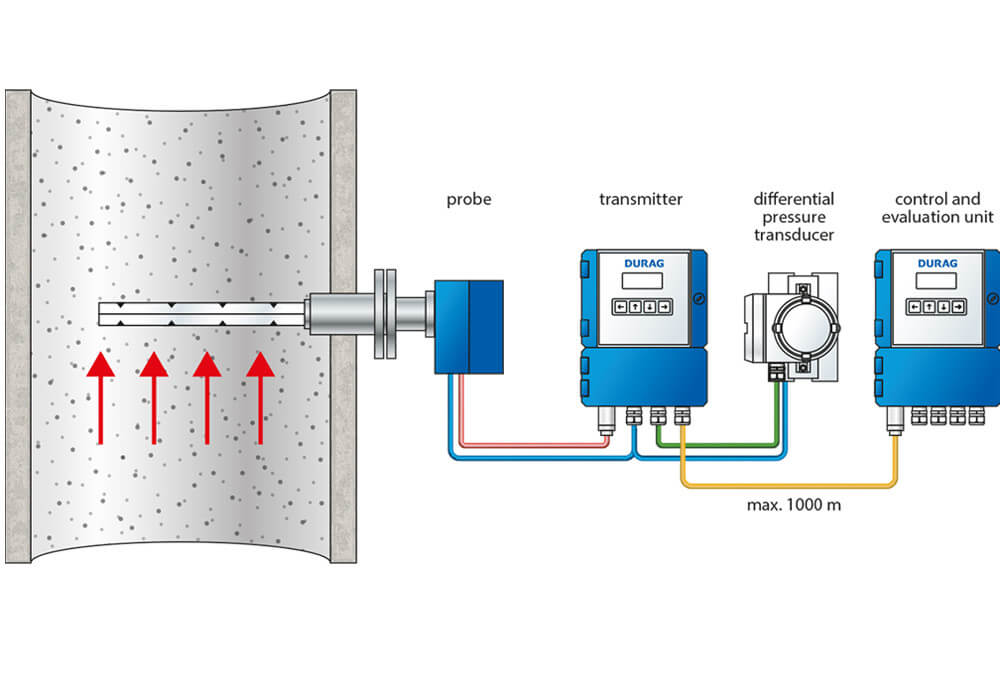
With Durag's tribo-electric dust monitors, you can continuously monitor dust penetration in a (dry) flue gas duct.
Durag's tribo-electric dust monitors offer reliable, continuous monitoring of dust penetration in (dry) flue gas ducts. By placing the probe downstream of the filter, you can easily and quickly check the condition of your dust filter system.
The measuring probe detects the charge transferred by dust particles during their collision with the probe (flow-dependent). The probe features an insert length of up to 1,000 mm. Optional configurations include ATEX-certified models and an external control unit.
Looking to measure more process variables? The tribo-electric dust monitor can be extended with integrated flow measurement (using the differential pressure method), as well as absolute pressure and temperature measurements.
Our VCA-certified specialists understand both your instrumentation and application and provide fast, expert support on site.
We support you throughout every stage of the process, from selection and integration to calibration, data interpretation, and maintenance.
We combine our expertise, instrumentation, and service to ensure your measurement solutions deliver optimal performance and maximum value.
Do you have a question or would you like to discuss your measurement challenges? Our specialists will be happy to help you find the most suitable solution.
Flexible moisture analysis independent of color, density and mass and quickly and accurately with microwave resonance technology.

Accurately measure particle size distributions in suspensions and emulsions. Due to wide dynamic range, very suitable for measuring nanoparticles.

Sofraser's benchtop and at-line viscometers offer precise, on-demand viscosity measurements at your location of choice.